
Marketing
How to Plan 30 Days of Business Content Without Losing Your Mind
A Simple Content System for Small Business Owners Who Do Not Have Time to Be Online 24/7
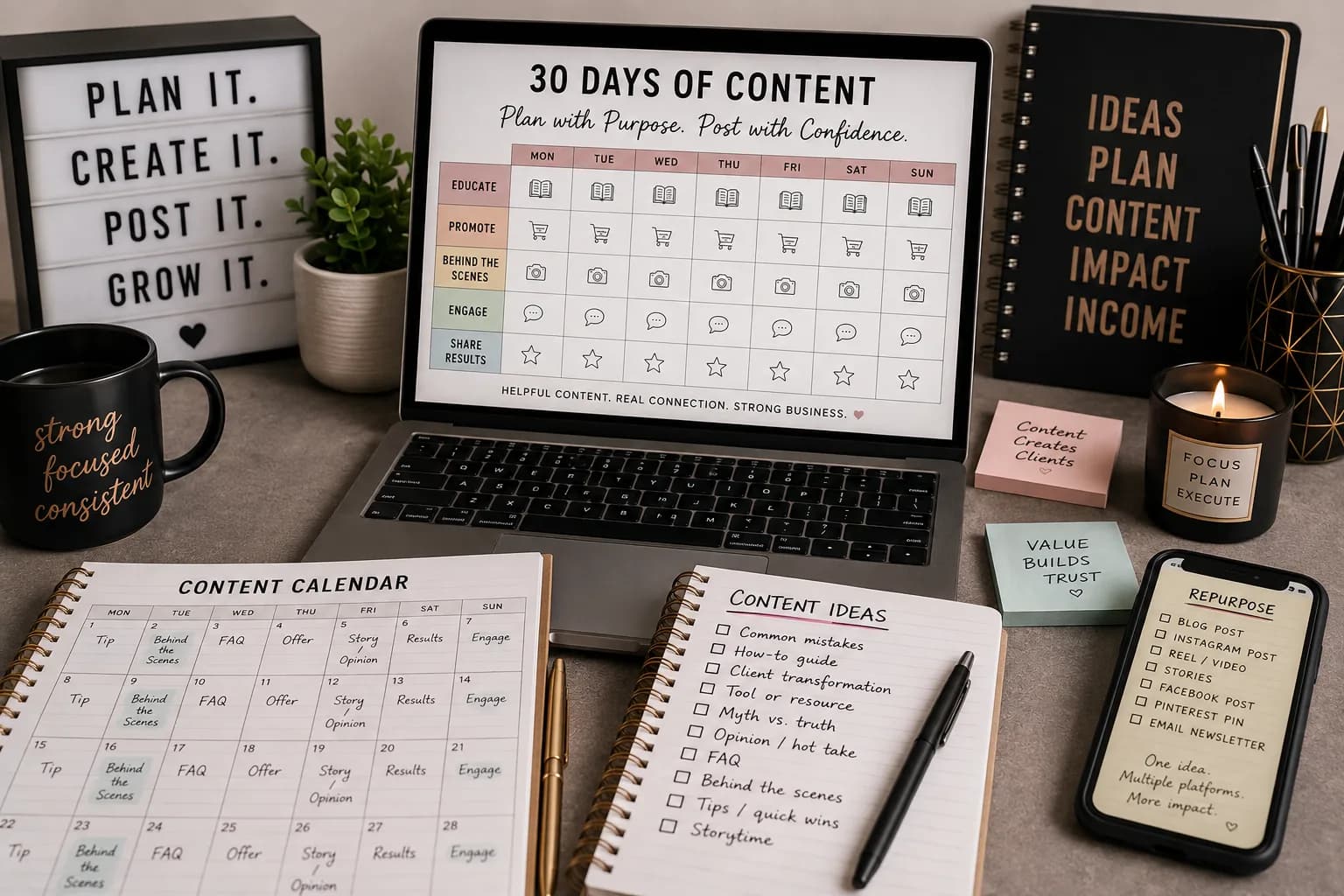
If planning content for your business currently looks like opening Instagram, staring at the blank caption box, immediately forgetting every thought you have ever had, and then deciding you will “post tomorrow,” this is for you.
You do not need 30 completely original genius ideas every month.
You do not need to spend every day filming yourself.
You definitely do not need to turn your entire life into content just because somebody on TikTok said consistency means posting four times a day.
You need a system.
A realistic one.
Because content is supposed to help run your business.
Your business is not supposed to exist so you have something to post about.
First: stop thinking you need 30 completely different ideas
This is usually where people make content planning way harder than it needs to be.
They sit down and think:
“Okay. I need 30 posts.”
And then their brain immediately files for unemployment.
Instead, start with a few bigger topics your audience actually cares about.
Let’s say you are a web designer.
Your audience may care about:
- why their website is not converting
- what makes a website look professional
- SEO basics
- how much a website should cost
- DIY website mistakes
- branding
- getting more customers online
That is already enough material to create dozens of posts.
You do not need 30 topics.
You need a handful of useful topics you can approach from different angles.
Create 4–6 content pillars
A content pillar is simply a category you regularly talk about.
Think of them as the buckets your content lives in.
For example, a photographer might use:
- education
- behind the scenes
- client work
- personal brand
- offers
- FAQs
A digital-product business might use:
- productivity tips
- business systems
- product demonstrations
- customer problems
- behind the scenes
- promotions
A hairstylist might use:
- hair education
- before and after
- maintenance tips
- client transformations
- booking information
- personality and behind the scenes
Your pillars keep you from waking up every morning and asking:
“What the hell am I supposed to post today?”
Dani’s practical check: If you cannot quickly think of at least five post ideas under a content pillar, it is probably too narrow to be one of your main pillars.
Use a simple 30-day structure
You do not have to make this complicated.
Let’s say you choose five content pillars.
You can rotate them throughout the month.
For example:
- Monday: educational content
- Tuesday: product or service
- Wednesday: behind the scenes
- Thursday: FAQ or objection
- Friday: opinion, story, or personality
- Saturday: proof, results, or testimonial
- Sunday: light engagement or recap
That does not mean you must post seven days a week.
If three posts a week is realistic for you, plan three.
If five is realistic, plan five.
Consistency is not about posting the maximum possible amount.
It is about creating a pace you can actually maintain.
Turn one idea into multiple posts
This is where content planning gets much easier.
One useful idea can become several pieces of content.
Let’s say your main topic is:
“Why your website is not converting visitors into customers.”
That can become:
- a Reel: “3 reasons people leave your website without buying”
- a carousel: “5 website mistakes killing your conversions”
- a Facebook post explaining one specific mistake
- a blog article covering the full topic
- an email with a website checklist
- a Story poll asking followers what they struggle with
- a Pinterest graphic leading to the blog article
That is seven pieces of content from one idea.
Stop treating every platform like it needs completely different intellectual property.
It does not.
The format changes.
The core idea can stay the same.
Start with the strongest piece of content
A good way to build content efficiently is to create one “anchor” piece first.
This might be:
- a blog post
- a long video
- a podcast episode
- a newsletter
- a detailed social post
Then pull smaller content from it.
For example, if you write a blog post with ten tips, you already have:
- ten possible short social posts
- ten video hooks
- several carousel ideas
- a checklist
- multiple email topics
This is much easier than sitting down separately to invent content for every platform.
Build a content idea bank before you need it
Do not wait until content-planning day to come up with every idea.
Keep a running list.
Every time you notice:
- a customer question
- a weird misconception
- a problem you solved
- something that annoyed you in your industry
- a mistake customers frequently make
- a lesson you learned
- a useful tool
- a before-and-after result
- a comment someone left
- a topic you explained in a DM
write it down.
Those are content ideas.
Your audience is literally telling you what to talk about.
If one person asked the question, there is a good chance someone else is wondering the same thing.
Customer questions are content gold
If you are ever stuck for content, start with the questions people ask before they buy.
For example:
- How much does it cost?
- How long does it take?
- What do I need before we start?
- Is this right for my business?
- What is included?
- Can I do this myself?
- Why would I choose this instead of the cheaper option?
- What happens after I buy?
Every single one of those can become content.
And unlike random trending topics, that content directly helps potential customers make decisions.
Use your own opinions
Educational content is useful.
But if every post sounds like something anyone could have copied from Google, people have no reason to follow you.
Your opinions create differentiation.
Examples:
- “Why I think most small businesses do not need to post every day”
- “Why I hate ‘DM for pricing’”
- “The website trend I wish would disappear”
- “Why I would rather have 500 email subscribers than 10,000 random followers”
- “What I would spend money on first if I were starting my business again”
You do not need to manufacture controversy.
Just explain what you actually believe and why.
That is usually more interesting than another post titled:
“5 Tips for Success!”
Do not make every post an advertisement
If every single post says:
“Buy my thing.”
people start tuning you out.
Your content should help people understand:
- the problem
- the possibilities
- your expertise
- your personality
- your process
- your results
Then your offer becomes the natural next step.
For example, instead of:
“I offer website redesigns. Book now!”
you could post:
“If your website looks good on desktop but turns into complete nonsense on a phone, you do not have a finished website yet. Here are four things I check first when fixing a mobile layout.”
Then:
“If you would rather not spend Saturday night fighting CSS, I offer website glow-ups.”
Now the sale makes sense.
But yes, you still need to sell
Do not swing too far in the opposite direction either.
Some business owners create months of useful content and then apparently expect customers to develop psychic abilities and figure out what they sell.
Tell people.
Regularly.
Talk about:
- your products
- your services
- your pricing
- what is included
- who it is for
- what problem it solves
- how to buy
- why you created it
- results customers have gotten
Selling is not annoying when the offer is relevant.
Running a business while being terrified to mention the thing that makes you money is a very difficult business model.
Create repeatable content formats
You do not need to reinvent your creative direction every week.
Create formats you can reuse.
For example:
- “3 things I would fix first…”
- “Stop doing this if…”
- “What nobody tells you about…”
- “Before you pay for ___, check this”
- “The biggest mistake I see…”
- “If I had to start over…”
- “Do you actually need ___?”
- “Here is exactly how I…”
- “What $___ actually gets you”
- “My unpopular opinion about…”
You change the topic while keeping the structure.
That saves a stupid amount of mental energy.
Batch by task, not necessarily by post
People hear “batch content” and imagine spending Sunday filming 30 videos until they hate their own face.
You do not have to batch everything at once.
Instead, batch similar tasks.
For example:
Monday: brainstorm ideas.
Tuesday: write captions.
Wednesday: create graphics.
Thursday: film videos.
Friday: schedule everything.
Your brain stays in one mode instead of constantly switching between writing, designing, filming, editing, researching, and scheduling.
That usually makes the process much faster.
Use AI to help with the repetitive parts
AI can be very useful for content planning when you do not ask it to manufacture your entire personality.
Give it your real ideas.
Then use it to help expand them.
For example:
“I run a bookkeeping business for freelancers. My audience struggles with inconsistent income, taxes, and keeping business expenses organized. Give me 20 educational content ideas divided between beginner questions, common mistakes, myths, and purchase-intent topics.”
Or:
“Here is my blog article. Turn the main ideas into 10 short-form video concepts, 5 Facebook posts, 5 Pinterest titles, and 3 email ideas. Do not repeat the same hook.”
That is useful.
Asking:
“Give me 30 viral posts for my business.”
is how you end up with 30 posts that sound like everybody else's 30 AI-generated posts.
A sample 30-day business content plan
Here is a simple structure you can adapt to almost any business.
- Day 1: Introduce the problem your business solves.
- Day 2: Answer a common customer question.
- Day 3: Show behind the scenes.
- Day 4: Share a quick educational tip.
- Day 5: Highlight a product or service.
- Day 6: Share a customer result or testimonial.
- Day 7: Ask your audience a question.
- Day 8: Correct a common misconception.
- Day 9: Share a mistake to avoid.
- Day 10: Explain your process.
- Day 11: Share a useful tool or resource.
- Day 12: Tell a short business story.
- Day 13: Show a before-and-after transformation.
- Day 14: Repurpose your strongest post from Week 1.
- Day 15: Explain who your offer is for.
- Day 16: Explain who your offer is not for.
- Day 17: Share three quick tips.
- Day 18: Answer another FAQ.
- Day 19: Share your opinion on an industry topic.
- Day 20: Promote your offer directly.
- Day 21: Share something personal but relevant to the brand.
- Day 22: Break down the cost or value of something.
- Day 23: Share a checklist.
- Day 24: Explain why a common DIY solution sometimes fails.
- Day 25: Show another behind-the-scenes moment.
- Day 26: Share proof, results, or a case study.
- Day 27: Turn an older piece of content into a new format.
- Day 28: Share a lesson you learned.
- Day 29: Answer an objection that keeps people from buying.
- Day 30: Recap the month and give one clear next step.
You can turn these into Reels, carousels, photos, Stories, emails, blog posts, or plain text.
The idea matters more than forcing everything into whatever format happens to be trending this week.
You do not have to post all 30 days
This is important.
A 30-day content plan does not necessarily mean you publish something every single day.
You might plan:
- 12 main posts
- 8 Stories
- 4 emails
- 2 blog posts
- 4 promotional posts
That is still 30 pieces of planned content.
Or maybe you use the 30 ideas over six weeks.
Your calendar is supposed to help you.
It is not parole.
Measure what actually matters
Do not decide whether content worked based only on likes.
Depending on your goal, pay attention to:
- website visits
- email signups
- DMs
- quote requests
- product-page visits
- sales
- saves
- shares
- comments
- watch time
- click-throughs
A post with 30 likes that brings two customers may be more valuable than a post with 2,000 likes from people who will never buy anything.
Attention is useful.
Relevant attention is better.
At the end of the month, do not start from zero again
This may be the most important part.
Look at what happened.
Ask:
- Which topics got the most useful engagement?
- Which posts brought website traffic?
- Which content led to inquiries or sales?
- Which questions kept coming up?
- Which format was easiest for me to produce?
- Which posts should I expand?
- Which posts could be republished later?
Then build the next month from that information.
You should not be reinventing your marketing strategy every 30 days.
You should be improving it.
Frequently asked questions
How often should a small business post?
There is no universal number.
Posting three useful pieces of content every week for six months is better than posting twice a day for nine days and then disappearing because you burned yourself out.
Choose a frequency that matches your available time, platform, audience, and business goals.
Should I post the same thing on every platform?
You can absolutely reuse the same core idea.
Adapt the format for the platform instead of creating entirely new topics.
A blog post may become a Facebook post, Instagram carousel, TikTok video, Pinterest graphic, and email.
That is repurposing, not laziness.
How far ahead should I plan content?
A month is usually far enough to remove daily stress without locking you into a plan that cannot respond to what is happening in your business.
You can leave a few spaces open for timely content, launches, news, trends, or things that happen during the month.
What if I plan content and then do not feel like posting it?
Then change it.
A content calendar is a plan, not a blood oath.
If something suddenly feels irrelevant, forced, or wrong for your audience, replace it.
The point of planning is to make content easier—not to remove your ability to think.
The bottom line
You do not need to spend your entire month thinking about what to post.
You need:
- a few strong content pillars
- a running idea bank
- repeatable formats
- a realistic publishing schedule
- intentional repurposing
- a system for reviewing what actually worked
Thirty days of content becomes much less intimidating when you stop trying to invent 30 unrelated masterpieces.
Create useful ideas.
Reuse them intelligently.
Say something worth remembering.
Sell the damn thing occasionally.
Then get back to running your business.
Need a system instead of another blank calendar?
If content planning is one of those things that somehow ends up on your to-do list every single week, build yourself a repeatable system instead.
Explore business planning, marketing, content, and productivity resources from Mac Management to help turn the chaos into something you can actually use.
Keep building with intention.
Explore the practical tools, services, and systems across the Dani Mac ecosystem when you need the next layer of support.
Explore resources →Related reading

Why Your Business Needs More Than an Instagram or Facebook Page
Instagram and Facebook can help people discover your business, but they should not be the entire foundation of it. Here is why relying only on social media puts your business at risk—and what you actually need to build a stronger online presence you control.
Read article →About Dani Mac
I’m an entrepreneur, designer, digital-product creator, author, and builder of several connected brands. I share what works, what needs testing, and what I would do differently.
Explore my work →