
Digital Products
How to Price a Digital Product Without Guessing
A Practical Way to Set a Price That Makes Sense for Your Product, Your Customer, and Your Business
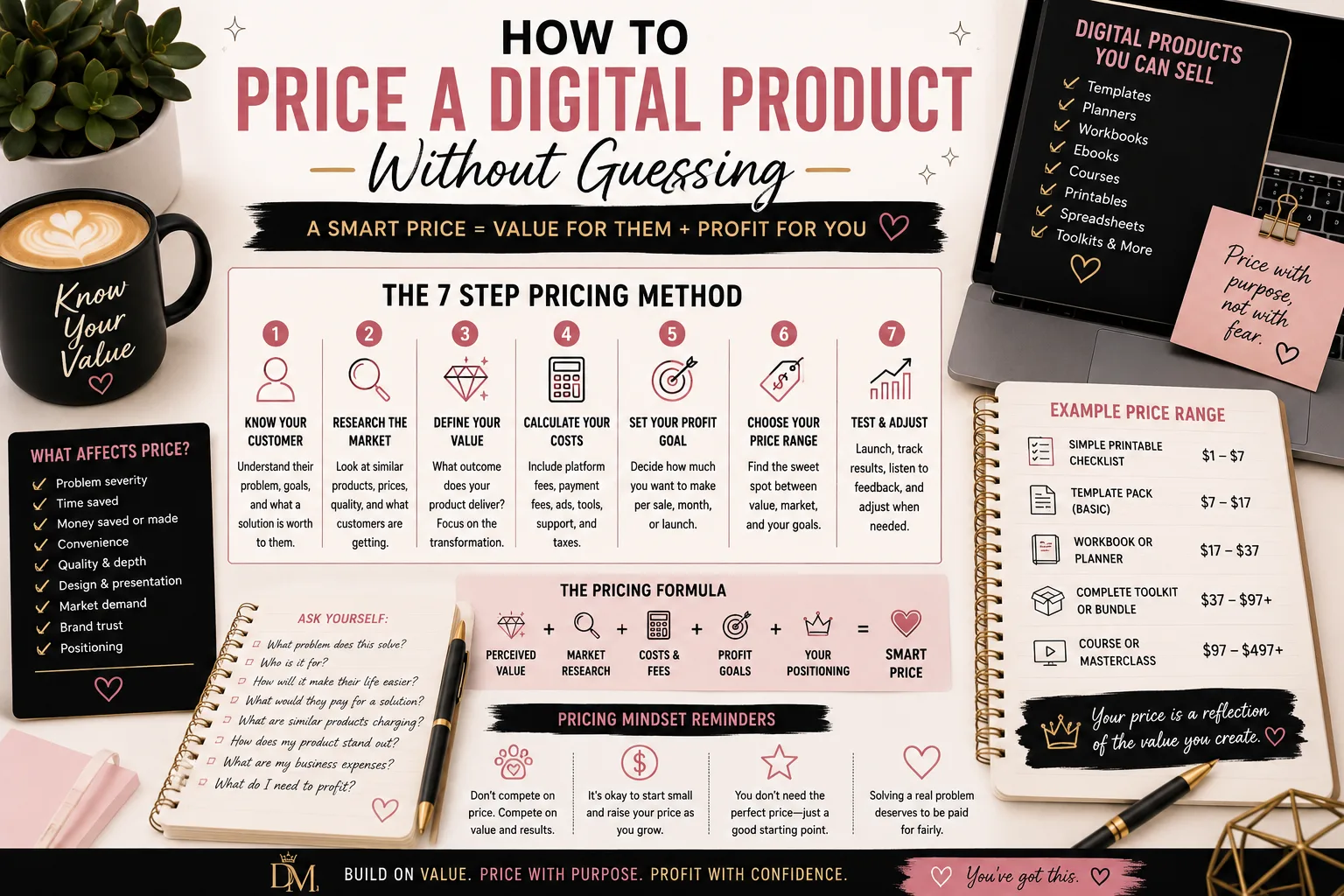
Pricing a digital product is weird.
You spend hours—or days, or weeks—creating something.
Then you get to the little box that says:
Price: $_____
and suddenly you forget everything you know about business.
Is $7 too cheap?
Is $27 ridiculous?
What if nobody buys it?
What if everybody buys it and you realize you basically gave it away?
Then you go look at competitors and somehow make the problem worse because one person is selling something similar for $2.99 and somebody else wants $97.
Perfect. Very helpful.
The good news is that you do not have to pull a number out of thin air.
A good digital-product price sits at the intersection of value, customer expectations, positioning, costs, and your actual business goals.
You are still going to make a judgment call.
But it can be an informed judgment call instead of:
“$12 sounds cute, I guess.”
First: stop pricing based only on how long it took you to make
This is probably the biggest mindset shift with digital products.
If you spend ten hours creating a planner, that does not automatically make it worth ten times more than something you created in one hour.
Your customer is not buying your time.
They are buying the result, convenience, information, design, organization, entertainment, or shortcut the product provides.
Think about two spreadsheets.
Spreadsheet A took someone 20 hours to build but does not really solve anything.
Spreadsheet B took four hours to build and saves a business owner five hours every month.
Which one is more valuable?
Probably Spreadsheet B.
The amount of work involved matters to you because it affects whether the product is worth creating.
It does not determine the customer's perceived value by itself.
Understand what your product actually does for somebody
Before choosing a price, answer this:
What does the buyer get out of this?
Not what files are included.
The actual outcome.
For example:
A budget spreadsheet does not just provide:
- 12 tabs
- formulas
- charts
- expense categories
It may help someone:
- understand where their money is going
- stop missing bills
- track business expenses
- see whether they are actually profitable
Those are benefits.
A social-media template pack is not just 50 Canva templates.
It may save a business owner hours of design work and help them create consistent content without staring at a blank screen every morning.
That is the value.
Dani’s practical check: If your sales page only explains what is inside the download and never explains what becomes easier, faster, clearer, or better after using it, you are probably underselling the product before anyone even sees the price.
Look at the market—but do not blindly copy it
Competitor research matters.
Copying the cheapest competitor does not.
Search for products that solve a similar problem and look at:
- their price
- what is included
- product quality
- design quality
- reviews
- bonuses
- brand positioning
- how detailed the product is
- what kind of customer they target
You are looking for a range.
Maybe similar products are selling for:
- $5–$12 at the low end
- $15–$29 in the middle
- $39–$79 for more premium versions
Now ask why.
Maybe the $7 product is a five-page printable.
Maybe the $27 product is a 70-page interactive workbook.
Maybe the $59 option includes videos, templates, examples, and lifetime updates.
That context matters.
If you only look at price, you are comparing numbers instead of products.
Do not let Etsy's cheapest listing set the value of your business
This deserves its own section.
You will always find somebody selling something ridiculously cheap.
Always.
You can find entire template bundles for $1.99.
That does not mean your product needs to cost $1.99.
The seller may:
- use low prices to generate volume
- have thousands of existing customers
- sell a lower-quality product
- make money through upsells
- use templates they can produce very quickly
- simply be underpricing themselves
You do not know their business model.
Do not copy a strategy you do not understand.
Know your minimum viable price
Digital products do not have the same per-unit costs as physical products, but they are not free to sell.
Your costs might include:
- marketplace fees
- payment-processing fees
- affiliate commissions
- advertising
- software subscriptions
- design assets
- fonts or licensing
- hosting
- email marketing
- customer support
- refunds
- taxes
If you sell a $3 product and lose a meaningful percentage of that sale to fees, suddenly “cheap and easy” becomes “I need 400 sales to pay the electric bill.”
Know what you actually keep.
Run the revenue math backward
This is one of the easiest ways to see whether your price makes sense.
Say you want one product to eventually generate $1,000 per month in gross sales.
If it costs:
- $5 → you need 200 sales
- $10 → you need 100 sales
- $20 → you need 50 sales
- $25 → you need 40 sales
- $50 → you need 20 sales
That does not mean you should slap a $50 price on a $5 product.
It means price changes the amount of traffic and sales volume your business needs.
A low-price strategy can work beautifully when you have enormous traffic.
If you are brand new and approximately 14 people know you exist, volume pricing may be a harder game.
Your audience changes what they are willing to pay
The exact same product can feel expensive to one customer and cheap to another.
A $29 spreadsheet marketed to a teenager tracking allowance money is very different from a $29 spreadsheet helping a freelancer track $80,000 in business income.
Think about:
- who the customer is
- how painful the problem is
- how urgently they want it solved
- what alternatives cost
- whether the product helps them make or save money
- how experienced they are
- how much trust you have built
Pricing exists in context.
Problem severity affects value
A cute printable grocery list might reasonably be inexpensive.
A detailed business-credit system that organizes complicated information, saves research time, and helps someone avoid expensive mistakes can support a higher price.
Why?
The second problem is more valuable to solve.
Products generally become easier to price higher when they help customers:
- make money
- save money
- save significant time
- reduce risk
- avoid frustration
- complete something complicated
- achieve an important goal
This does not mean making ridiculous promises.
Do not claim your $19 PDF will make somebody a millionaire by Thursday.
It means understanding the actual importance of the problem.
Convenience has value
Never underestimate this.
A buyer may technically be able to find all the information in your product for free.
That does not automatically make the product worthless.
People pay for:
- organization
- curation
- clear instructions
- templates
- examples
- design
- time savings
- having everything in one place
I can technically watch 63 YouTube videos and read 14 websites to learn something.
Or I can pay somebody $25 because they already organized the entire damn process.
Sometimes convenience is the product.
Presentation affects perceived value
People absolutely judge digital products by how they look.
They should not judge quality entirely by appearance.
They still do.
A professionally designed, polished workbook with:
- clear typography
- intentional layouts
- good navigation
- useful instructions
- consistent branding
- quality mockups
usually supports a stronger price than a document that looks like someone exported a Google Doc five minutes before lunch.
Design does not replace usefulness.
But design communicates care.
Your product page affects what the price feels like
You can have a genuinely valuable $29 product and make it look overpriced with a terrible listing.
If the sales page gives me:
- one blurry image
- three sentences
- no preview
- no explanation
- no clear outcome
$29 suddenly feels risky.
Show people what they are getting.
Your listing should make clear:
- who the product is for
- what problem it solves
- what is included
- how it works
- what format it comes in
- what software is needed
- what results or benefits to reasonably expect
A stronger presentation can increase perceived value without changing the actual product.
Different digital products naturally support different price ranges
There is no universal pricing chart, but product depth matters.
Something simple like:
- a one-page checklist
- a small printable set
- a basic template
will usually sit lower than:
- a complete workbook
- a professional template system
- a large business toolkit
- a detailed course
- a comprehensive bundle
Again, there are exceptions.
A single spreadsheet that solves an expensive business problem may be worth more than a 100-page ebook nobody actually needs.
Page count is not value.
Do not price by file count either
“Includes 972 files!” sounds impressive until 900 of them are basically useless.
Customers do not necessarily need more.
They need enough.
If 20 carefully designed templates solve the problem better than 400 mediocre ones, the smaller product may deserve the higher price.
Use pricing tiers when they actually make sense
Instead of forcing one product to serve everybody, you can sometimes create levels.
For example:
Starter — $9
- basic template
- core instructions
Complete — $27
- full template collection
- guide
- examples
- bonus worksheets
Premium — $49
- everything above
- additional tools
- advanced templates
- future updates
Now the customer can choose based on what they need.
And you do not have to make your entire audience agree on one price.
Bundles can increase order value without making individual products expensive
Say you sell four products for $12 each.
Bought separately:
$48
You might offer the bundle for:
$35
The customer saves money.
You make a larger sale.
Everybody wins.
Bundles work especially well when products naturally belong together.
Randomly throwing six unrelated PDFs into a ZIP file and calling it the “Ultimate CEO Empire Bundle” is less convincing.
Use introductory pricing carefully
Launching at a lower price can make sense.
You might use:
- founding-customer pricing
- launch-week pricing
- early-access pricing
- beta pricing
That gives you a chance to:
- get initial customers
- collect feedback
- find confusing areas
- build reviews
- validate demand
But tell people the price is introductory.
Otherwise you can accidentally train your audience to think that lower price is the normal price.
You are allowed to raise your prices
Your first price is not a legally binding lifelong commitment.
If you:
- improve the product
- add content
- add bonuses
- get strong reviews
- build your audience
- increase demand
- realize the original price makes no financial sense
raise it.
You do not need permission.
A digital product can evolve.
Its price can evolve too.
And yes, you can lower a price that is not working
Raising prices gets talked about constantly online because it sounds empowering.
Sometimes the correct business decision is lowering one.
If customers clearly see value but the price is creating resistance, test another price.
But do not automatically assume price is the problem.
If nobody is buying, the issue could also be:
- bad traffic
- weak positioning
- poor product images
- a confusing sales page
- low trust
- the wrong audience
- a product nobody actually wants
Dropping the price will not fix a product-market problem.
Discounts should have a reason
If your product is permanently 70% off, it is not 70% off.
That is just the price wearing a little red sticker.
Use discounts strategically for things like:
- launches
- holidays
- bundles
- email subscribers
- customer loyalty
- limited promotions
Constant discounting can teach customers to wait.
Why buy it for $29 today if they know you are going to panic and sell it for $7 next Friday?
Charm pricing is optional, not a religion
You will see prices like:
- $7
- $9
- $17
- $27
- $47
- $97
all over digital-product businesses.
There are psychological reasons businesses use prices ending in 7, 9, or 5.
But there is no magical law stating your ebook must cost $17 because somebody with a Lamborghini in their Instagram bio said so.
You can use:
- $19
- $20
- $24
- $25
- $30
Choose the number that fits your positioning.
Luxury brands often use cleaner round pricing.
Marketplace products often use charm pricing.
Test instead of worshiping rules.
Your price communicates positioning
Price is not only about money.
It sends a signal.
If a highly polished, comprehensive professional toolkit costs $2.99, some customers may actually become suspicious.
They may assume:
- it is low quality
- it is copied
- it is very basic
- there is a catch
Cheap does not automatically equal attractive.
Likewise, expensive does not automatically equal premium.
You still need to earn the higher positioning.
Consider where you are selling
A product can perform differently depending on the marketplace.
Buyers on one platform may expect:
- lower prices
- frequent discounts
- instant downloads
Customers shopping directly from a specialized brand may be more comfortable paying a premium for a more comprehensive product.
That does not mean you need totally different prices everywhere.
It means you should understand the buying environment.
Do not forget affiliate commissions
If you plan to use affiliates, build that into your pricing.
Suppose your product sells for $20.
If you pay a 30% affiliate commission, that is:
$6
before payment fees, taxes, refunds, advertising, or other costs.
That may still be perfectly profitable.
Just know the math before promising half the sale to affiliates because 50% sounded generous at 1:00 a.m.
Create a pricing scorecard
If you are stuck between two or three prices, score the product.
Ask yourself:
- How important is the problem?
- How much time does the product save?
- Can it help the customer make or save money?
- How complete is the solution?
- How professional is the presentation?
- How strong is my brand trust?
- What do comparable products cost?
- How much support comes with it?
- How much traffic or sales volume do I realistically have?
- Will this price leave enough margin after expenses?
You will usually start seeing where the product belongs.
A simple digital-product pricing method
If you want an actual process instead of vibes, use this:
Step 1: Research comparable products
Find at least five genuinely similar products.
Write down:
- price
- size
- features
- quality
- customer type
Step 2: Define your product's outcome
Write one sentence explaining what becomes easier or better after someone uses it.
Step 3: Identify your differentiators
Why should someone choose yours?
Maybe it is:
- better design
- more detailed instructions
- a specific niche
- better organization
- included templates
- bonuses
- accessibility
- ease of use
Step 4: Calculate your real costs
Include fees, marketing, commissions, support, and software.
Step 5: Choose a realistic range
Do not choose one number yet.
Maybe the product makes sense somewhere between:
$19 and $29.
Step 6: Look at your positioning
If the product is intentionally premium and clearly better than lower-priced alternatives, choose toward the higher end.
If you are entering a crowded marketplace with no audience or reviews, starting lower may help you gather data.
Step 7: Launch and watch what happens
Your first price gives you data.
It does not give you a tattoo.
Pay attention to the right signals after launch
Do not judge a price from three random comments.
Look at actual behavior.
Track things like:
- product-page visits
- conversion rate
- sales volume
- refunds
- average order value
- coupon usage
- customer questions
- abandoned carts
If 1,000 highly relevant people visit and almost nobody buys, something needs investigation.
If 14 people visit and nobody buys, you do not have enough information to declare the price a disaster.
You might just need traffic.
Listen to what customers say—but also watch what they do
People will tell you:
“I would totally buy this for $10.”
Then you release it for $8 and they disappear into the mist.
Customer feedback is useful.
Purchasing behavior is better.
Test with real sales whenever possible.
Frequently asked questions
What is a good price for an ebook?
There is no universal price.
A short general-interest ebook may reasonably sit at a lower price than a detailed specialized guide that solves an expensive problem.
Look at comparable products, the depth of the information, audience expectations, and how valuable the outcome is.
What should I charge for a digital planner?
It depends heavily on the planner.
A simple printable planner is a different product from a large hyperlinked planner with specialized worksheets, navigation, bonuses, and multiple formats.
Do not price them as if they are interchangeable.
Should I start cheap because I am new?
You can use a lower introductory price, but “I am new” does not automatically mean your work has no value.
If the product is professional and useful, price the product—not your follower count.
What if nobody buys?
Do not immediately slash the price.
Check:
- whether enough people saw it
- whether the right people saw it
- whether the product solves a real problem
- whether the listing communicates its value
- whether customers trust the business
Price is only one variable.
Should I show the regular price and a sale price?
Only if there is a genuine regular price.
Do not manufacture fake discounts just to make the product seem more valuable.
Your pricing should build trust, not require creative accounting.
The bottom line
There is no formula that can tell you the one perfect price for every digital product.
But that does not mean pricing has to be random.
Look at:
- the problem you solve
- the customer you serve
- the value you provide
- the market
- your positioning
- your expenses
- your revenue goals
- real customer behavior
Then choose a price.
Launch it.
Measure it.
Adjust it.
Pricing is a business decision, not a personality test.
You do not need to prove that you value yourself by charging $97.
You also do not need to sell three weeks of work for $4 because somebody else does.
Build something useful.
Price it intentionally.
Then let the market give you information.
Building digital products of your own?
If your brain is currently full of product ideas, launch plans, prices, listings, and fourteen things you swear you are going to finish this week, Mac Management has planning systems and business tools designed to help turn all of that into an actual product people can buy.
Keep building with intention.
Explore the practical tools, services, and systems across the Dani Mac ecosystem when you need the next layer of support.
Explore resources →Related reading
25 Digital Product Ideas You Can Create and Sell Online
Explore 25 realistic digital product ideas across beginner, intermediate, and advanced skill levels.
Read article →About Dani Mac
I’m an entrepreneur, designer, digital-product creator, author, and builder of several connected brands. I share what works, what needs testing, and what I would do differently.
Explore my work →