
Productivity and Planning
How to Motivate Yourself Daily as a Solopreneur
How to Keep Moving When Nobody Is Checking on You, Pushing You, or Making You Show Up
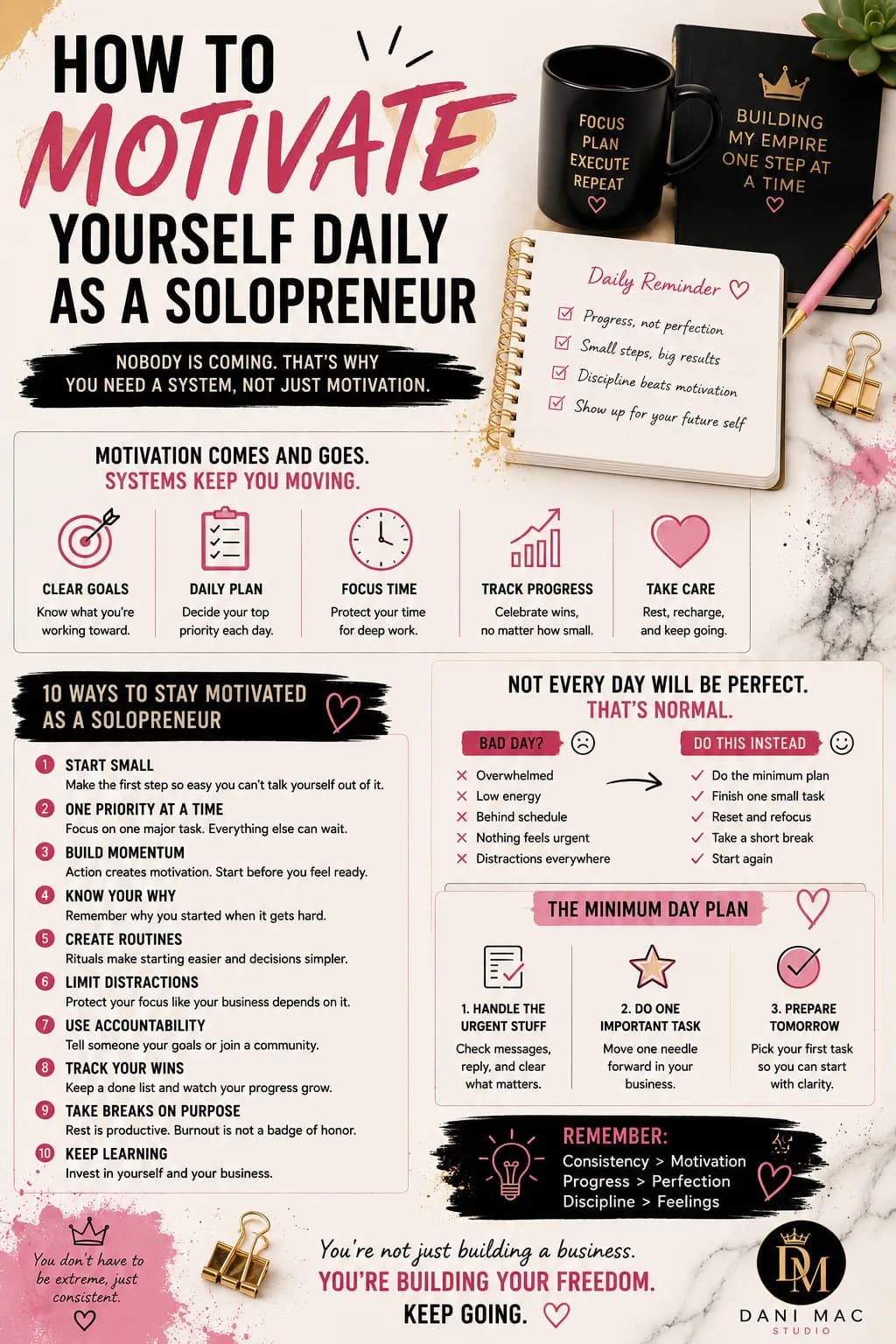
One of the best parts of working for yourself is that nobody is standing over you telling you what to do.
One of the worst parts of working for yourself is that nobody is standing over you telling you what to do.
There is no manager checking whether you started.
No coworker waiting on your part of the project.
No time clock quietly judging you from the wall.
If you decide to spend three hours reorganizing your Canva folders instead of doing the thing that actually makes money, technically nobody can stop you.
Which is why motivation becomes such a big deal when you are a solopreneur.
But here is the part I think people get wrong:
You are not supposed to feel motivated every day.
You need a way to keep moving even on the days when motivation does not show up.
Stop waiting to feel ready
Motivation is unreliable.
Some mornings you wake up ready to rebuild your entire business before lunch.
Other mornings opening your email feels like an unreasonable request.
If your business only moves when you feel inspired, progress is going to be painfully inconsistent.
I try to think about motivation as a bonus.
When it is there, great.
Use it.
When it is not, I still need a smaller version of the plan.
Instead of asking:
“Do I feel motivated enough to work today?”
ask:
“What is the smallest useful thing I can finish today?”
That question is much easier to answer.
Give yourself one real priority
Nothing kills motivation faster than looking at a list of 42 things that all apparently needed to be done yesterday.
I am much more productive when I know the one thing that matters most.
Not twelve priorities.
One.
That might be:
- finish the sales page
- send the proposal
- upload the new product
- write the blog post
- complete the client revision
- fix the checkout problem
If I finish that, the day moved forward.
Everything else is extra.
Dani’s practical check: If you completed only one thing today, which task would make you feel like the day still counted?
Make the first task stupidly easy to start
Starting is usually harder than continuing.
So I try not to make my first step:
“Finish entire project.”
That is not a step.
That is a threat.
Break it down.
Instead of:
Build sales page
try:
- open the project
- write the headline
- outline the sections
- choose the product images
Once you are moving, continuing is usually easier.
The goal is to reduce the amount of resistance between you and the work.
Use momentum instead of motivation
Momentum is more useful than motivation because momentum comes from action.
You answer one email.
Then another.
You write one paragraph.
Then the next one.
You upload one product.
Suddenly you are fixing the listing too.
This is why I like starting with something small but connected to real work.
Not fake productivity.
Cleaning your entire desktop may feel productive.
But if the thing you are avoiding is launching your offer, a beautifully organized desktop is not paying you.
Know the difference between low motivation and low energy
These are not always the same problem.
Sometimes you are not lazy or unmotivated.
You are tired.
Or mentally overloaded.
Or you have been making decisions for six straight hours.
If your energy is low, forcing yourself into the hardest possible task may not be the smartest move.
Match the work to the energy you actually have.
High-energy work
- strategy
- writing
- design
- sales
- big decisions
- complex problem solving
Lower-energy work
- uploading files
- formatting
- organizing assets
- basic admin
- scheduling content
- checking links
You still make progress without demanding peak performance from yourself every hour.
Stop building schedules for a fictional version of yourself
This is one I have had to learn repeatedly.
Do not build your daily schedule around the person you imagine you are going to become Monday morning.
You know her.
She wakes up at 5:30.
Works out.
Journals.
Answers every email.
Creates a month of content.
Builds three products.
Drinks eight glasses of water.
And apparently does all of this before noon.
If that is genuinely your life, fantastic.
If it is not, stop scheduling for her.
Create a workload based on what you can consistently do.
A realistic system beats an aspirational schedule you abandon every three days.
Create a start-of-day ritual
Your brain likes cues.
A simple routine can tell it:
Okay. We are working now.
It does not need to be some elaborate CEO morning routine.
Mine could be as simple as:
- open the planner or task list
- check the top priority
- close unnecessary tabs
- put the phone somewhere less interesting
- start the first task
The repetition matters more than the ritual itself.
Decide tomorrow's first task before you stop today
This is one of the easiest productivity tricks I know.
Before finishing work, decide what you are starting with tomorrow.
Not:
“Work on business.”
Something specific.
For example:
“Tomorrow I am opening the new product listing and writing the description first.”
Now you do not spend the first 45 minutes of the morning deciding what you should be doing.
Decision fatigue is sneaky.
Remove decisions wherever you can.
Keep your goals somewhere you can actually see them
I am not talking about making a vision board and then expecting the universe to handle fulfillment.
I mean literally knowing what you are working toward.
If your goal this month is:
$3,000 in revenue
then your daily work should somehow connect to that.
If your goal is:
launch three new products
then spending four days redesigning your About page might not deserve priority.
Goals help you decide what gets your attention.
Without them, everything feels equally important.
Track progress you can see
Progress is motivating.
The problem is that a lot of business progress is invisible while it is happening.
You might work for days before something launches.
So create visible evidence.
Track things like:
- products finished
- sales
- leads
- blog posts published
- emails sent
- client projects completed
- website pages finished
- content created
There is something extremely satisfying about seeing:
0 → 1 → 2 → 3
instead of feeling like you have been working forever and accomplishing nothing.
Use a done list, not just a to-do list
This sounds small, but it helps.
Your to-do list only shows what is still wrong with your life.
It does not show anything you already finished.
At the end of the day, write down what you completed.
Maybe it was:
- sent two proposals
- finished product mockups
- published blog post
- fixed checkout
- answered customer emails
That is progress.
If all you see is what remains unfinished, you can work all day and still feel like you did nothing.
Give yourself deadlines even when nobody else does
When you work for yourself, things can remain “almost done” for an impressive amount of time.
There is always:
- one more edit
- one more feature
- one more graphic
- one more page
- one more improvement
Eventually you need a deadline.
Not because everything has to be rushed.
Because projects expand to fill whatever time you give them.
“I will launch when it is ready” can easily turn into “I have redesigned the cover six times and nobody can buy it yet.”
Use external accountability when self-accountability is not enough
Working alone does not mean you have to do everything alone.
Accountability can help when you keep moving your own deadlines.
That might mean:
- telling a friend what you are finishing today
- using a coworking session
- joining an entrepreneur group
- setting a public launch date
- working alongside somebody virtually
Sometimes simply knowing another human knows what you said you would do is enough to get you moving.
Remove distractions before relying on willpower
I do not believe in making everything harder than necessary just to prove you have discipline.
If your phone is the problem, move it.
If social media keeps eating an hour, log out.
If 75 browser tabs are distracting you, close 70 of them.
If notifications constantly interrupt you, turn them off while you work.
Your environment should make the useful thing easier.
Willpower is not an infinite resource.
Stop confusing research with progress
This one gets me because research feels responsible.
You can research:
- competitors
- pricing
- platforms
- marketing strategies
- fonts
- tools
- SEO
forever.
Eventually research becomes avoidance.
At some point you have enough information to act.
Set a limit.
For example:
“I am researching this for one hour, then I am choosing.”
Otherwise you can spend three days comparing tools for a task that would have taken two hours manually.
Stop letting comparison destroy your motivation
Nothing will kill your desire to work faster than opening social media and seeing somebody announce:
“I made $87,000 this month while working 11 minutes a week!”
Cool.
Maybe they did.
Maybe they did not.
Either way, that information does not finish your project.
Comparison makes you judge your middle against somebody else's highlight reel.
Pay attention to useful strategies.
Ignore the scoreboard when it stops helping you.
Remember why you wanted this in the first place
There will be days when running a business feels less like freedom and more like voluntarily creating 47 jobs for yourself.
That is when it helps to remember why you started.
Maybe you wanted:
- more money
- more flexibility
- control over your schedule
- creative freedom
- something of your own
- a way out of a job you hated
- a better future for your family
Your reason does not have to sound inspirational enough to go on a coffee mug.
It just has to matter to you.
Money can be motivation too
I think business advice sometimes gets weird about this.
You are allowed to want your business to make money.
You are allowed to be motivated by:
- paying your bills
- getting out of debt
- buying a house
- building savings
- having more freedom
- never asking a manager for permission to take Tuesday off again
You do not need to pretend every task is fueled by passion and purpose.
Sometimes the motivation is:
I would like money.
Completely valid business objective.
Build rewards into the process
Everything does not need to be delayed gratification until your business makes a million dollars.
Give yourself smaller rewards.
Finish the product?
Watch the show.
Complete the client work?
Order something good.
Finish the week strong?
Take the afternoon off.
Your brain responds to reward.
Use that instead of treating yourself like an employee you hate.
Do the money-making task before the decorative task
This rule saves me from myself.
Creative business owners can spend an incredible amount of time making things prettier.
Sometimes prettier matters.
Sometimes you are adjusting a shade of pink for 45 minutes because sending the sales email feels uncomfortable.
Ask:
What task is closest to revenue?
That might be:
- sending the proposal
- publishing the listing
- following up with the lead
- finishing the checkout page
- promoting the offer
Do that before reorganizing the brand board again.
Learn how to restart a bad day
One of the worst productivity habits is deciding the whole day is ruined because the morning went badly.
You woke up late.
You got distracted.
You had to deal with something unexpected.
Suddenly it is 2:00 p.m. and your brain says:
“Well. Tomorrow it is.”
No.
You can restart at 2:07.
You do not need a new day, new week, new month, or new planner.
You need the next useful action.
Have a minimum-day plan
This is one of the best things you can create for yourself.
Decide what counts on days when you have almost nothing to give.
Your minimum business day might be:
- check urgent customer messages
- complete one revenue-related task
- do one thing that moves an active project forward
That is it.
Some days you will do ten times more.
Some days the minimum is the win.
A minimum-day plan keeps a bad day from becoming complete disengagement.
Do not punish yourself for needing a break
You are not a machine.
And even machines overheat.
Rest is not the enemy of productivity.
Unplanned burnout is.
If you never stop, eventually your body or brain may choose the stopping point for you.
Take breaks before everything feels unbearable.
Take a day off.
Go somewhere.
Do something unrelated to your business.
Your company will survive an afternoon without you refreshing analytics.
Create weekly wins instead of demanding perfect days
Daily productivity is messy.
I prefer looking at the week.
Maybe Monday was terrible.
Tuesday was average.
Wednesday you got a ridiculous amount done.
By Friday, the important work still moved forward.
That is a productive week.
You do not need seven perfect days.
You need enough good decisions across the week to create progress.
A simple daily motivation system
If you want something you can actually use tomorrow, try this:
- Choose your number-one priority.
- Break it into the smallest useful first action.
- Start before checking unnecessary distractions.
- Match harder tasks to your best energy.
- Finish one revenue-related task.
- Record what you completed.
- Choose tomorrow's first task before stopping.
That is enough structure to create momentum without turning your day into a military operation.
Frequently asked questions
How do I stay motivated when my business is not making money yet?
This is one of the hardest stages because you are putting in effort before getting much feedback.
Focus on leading indicators you can control:
- offers created
- people contacted
- content published
- products launched
- sales conversations
- website traffic
You still need to pay attention to whether the business model is working, but early progress is not measured only in revenue.
What if I am constantly procrastinating?
Figure out what you are avoiding.
Sometimes a task is too large.
Sometimes you do not know the next step.
Sometimes you are afraid of the result.
Sometimes you are simply exhausted.
Different causes require different fixes.
Should I force myself to work every day?
No.
You need a business rhythm that is sustainable for your actual life.
Consistency does not mean never resting.
It means returning to the work repeatedly over time.
What if I work better at night?
Then work at night if your life allows it.
The entrepreneurship police are not coming because you did not join the 5:00 a.m. club.
Use the hours when your brain works best.
How do I stay motivated when I have too many ideas?
Capture the ideas without immediately turning them into active projects.
Keep an idea bank.
Then choose based on your current goals, revenue potential, deadlines, and available time.
An idea does not become urgent simply because it arrived dramatically.
The bottom line
You are not going to feel motivated every day.
Neither am I.
The goal is not to become a person who jumps out of bed every morning screaming:
“I CANNOT WAIT TO DO ADMIN!”
That person sounds exhausting.
The goal is to create enough structure that your business can keep moving whether motivation shows up or not.
Know what matters.
Make starting easier.
Protect your energy.
Track your progress.
Finish things.
Rest when you need to.
Then come back.
You do not need perfect motivation. You need enough momentum to keep going.
Need a system that helps you keep moving?
If your motivation currently depends on sticky notes, panic, and remembering what you were supposed to be doing before you opened another browser tab, Mac Management is built for that exact kind of real-life productivity.
Explore planners, business systems, and practical tools designed to help you organize the work, choose what matters, and actually finish things.
Keep building with intention.
Explore the practical tools, services, and systems across the Dani Mac ecosystem when you need the next layer of support.
Explore resources →Related reading
About Dani Mac
I’m an entrepreneur, designer, digital-product creator, author, and builder of several connected brands. I share what works, what needs testing, and what I would do differently.
Explore my work →