Behind the Business
How I Organize Multiple Brands Without Pretending It Is Always Easy
The Systems I Use to Keep Different Businesses Moving Without Acting Like I Have My Shit Together 24/7
I run multiple brands.
Which sounds very organized and CEO-ish until you realize it sometimes means I have twelve browser tabs open, three notebooks beside me, two completely unrelated products half-finished, and a random idea I absolutely cannot stop thinking about even though it has nothing to do with what I was supposed to be working on.
So no, I am not about to tell you that managing multiple businesses is easy if you just buy the right planner and wake up at 5:00 a.m.
I would personally like to fight whoever started that rumor.
What I can tell you is that multiple brands become much easier to manage once you stop treating every idea like an emergency and start building systems around how you actually work.
That has been the biggest lesson for me.
I do not need perfect organization. I need enough organization that I know what matters next.
Why I have multiple brands in the first place
One of the first questions people might reasonably ask is why I do not just put everything under one business.
Because everything I create does not serve the same customer or need the same identity.
Dani Mac Studio is different from Mac Management.
My blog has a different job from my product shop.
Books need a different buying experience from custom website services.
They can all live inside the same larger ecosystem without being shoved under one confusing logo and homepage.
That distinction matters.
A brand should exist because it helps customers understand what they are looking at—not because you wanted another Instagram account to neglect.
Dani’s practical check: If two offers have different customers, different buying journeys, different positioning, or completely different personalities, separate brands may make sense. If they are basically the same business wearing different hats, you may just be creating extra work.
I give every brand one clear job
This is probably the most important part of the whole system.
Each brand needs a reason to exist.
Not a vague mission statement filled with words like innovation, empowerment, and excellence.
An actual job.
For example:
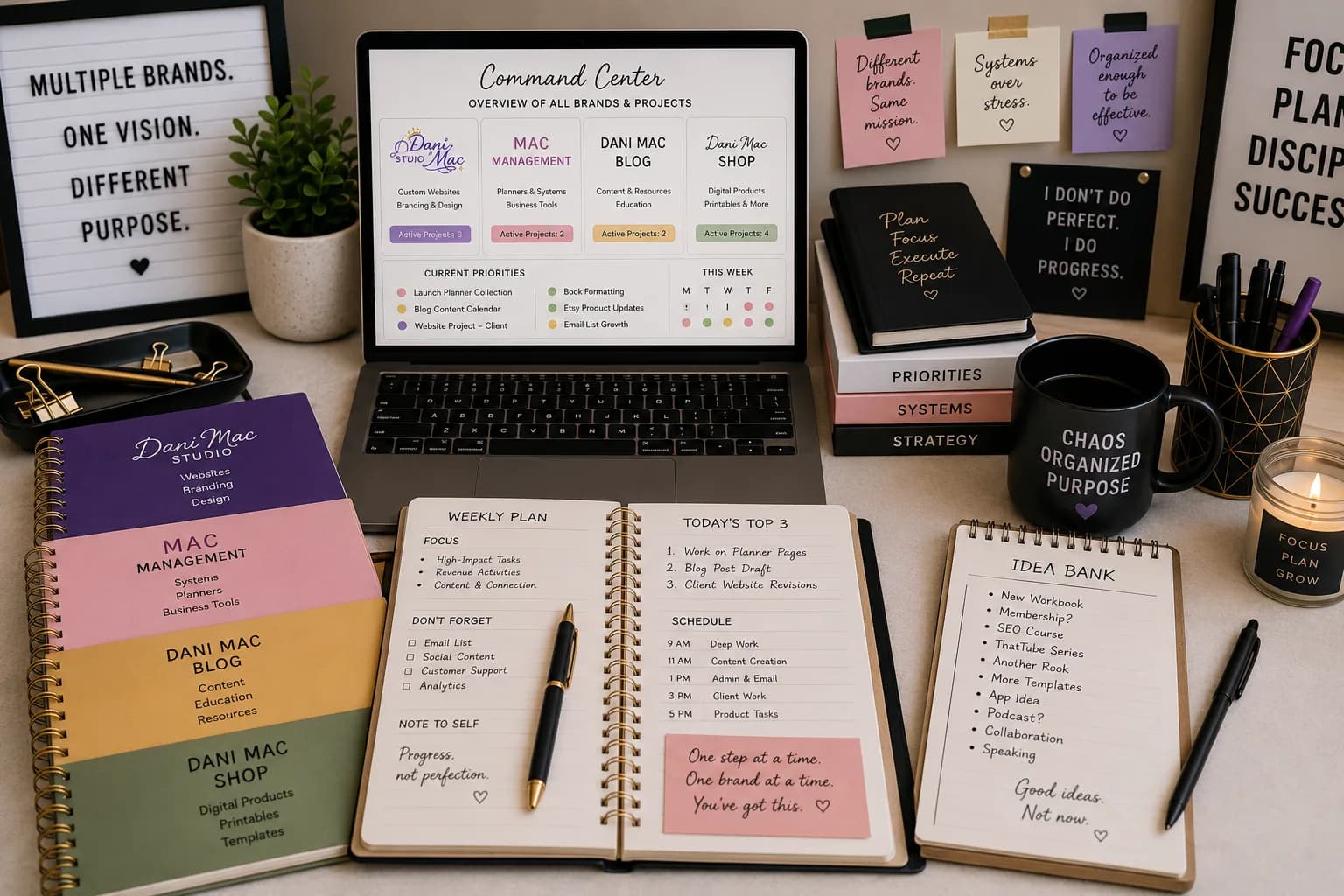
- Dani Mac Studio: custom design, branding, websites, and digital presence work
- Mac Management: planners, systems, workbooks, organization, and business tools
- Dani Mac Blog: useful business, marketing, AI, design, and entrepreneurship content
- Dani Mac Shop: digital products and ready-to-use resources
When I have an idea, I ask:
Which brand is this actually for?
If I cannot answer that quickly, the idea probably needs more work.
This stops everything from bleeding into everything else.
I do not work on every brand every day
This one took me a while.
When you have multiple businesses, there is a temptation to touch all of them every day so nothing feels neglected.
That is a fantastic way to accomplish approximately 13% of 47 things.
I work better when I let one brand or project have the majority of my attention for a block of time.
That might be:
- a few hours
- a full day
- several days during a launch
- a week when something needs serious work
If I am building products for Mac Management, I would rather stay in that world long enough to actually make progress than jump to website client work, then blog writing, then book formatting, then back to a planner.
Context switching is expensive.
Not financially.
Mentally.
Every time you switch projects, your brain has to reload the entire damn business.
I separate maintenance work from growth work
This changed the way I look at my workload.
Every brand has maintenance tasks.
Things like:
- answering messages
- updating products
- checking orders
- fixing broken links
- posting content
- handling admin
- making small website edits
Those tasks matter.
But maintenance can consume your entire week while giving you the illusion that you are growing.
Growth work is different.
That includes:
- launching a new product
- building a new sales page
- creating a lead magnet
- improving SEO
- developing a new service
- creating a content system
- building partnerships
- improving conversion rates
I try to know which kind of work I am doing.
If I spend five days answering emails and tweaking tiny things, I was busy.
I was not necessarily moving the business forward.
I keep one master view of everything
I do not want to open five different systems just to remember what I am supposed to be doing.
I need one place where I can see the big picture.
My master view needs to answer:
- Which brands have active projects?
- What is launching?
- What is unfinished?
- What has a deadline?
- What is blocked?
- What is making money?
- What needs attention?
- What can wait?
The individual brands can have their own systems underneath that.
But I need one command center above all of them.
Otherwise I end up relying on memory.
My memory is excellent at remembering a completely random product idea at 2:17 a.m.
It is less reliable when asked what deadline I gave myself on Tuesday.
Every idea goes somewhere
I have a lot of ideas.
Some of them are good.
Some are terrible.
Some seem brilliant for approximately six hours and then I look at them the next morning like:
“Who authorized this?”
The important part is that I do not immediately turn every idea into a project.
I capture it first.
I keep idea lists for things like:
- products
- books
- blog posts
- website features
- marketing campaigns
- business ideas
- content
- brand improvements
Once the idea is written down, my brain does not have to keep screaming:
DO THIS RIGHT NOW OR YOU WILL FORGET IT FOREVER.
Then I can decide later if it deserves actual time.
I separate ideas from active projects
This is a huge distinction.
An idea is:
“I should create a workbook about this.”
An active project is:
“I am creating this workbook this week, here are the sections, and here is what needs to happen before it can be sold.”
Those are not the same thing.
If every idea becomes an active project, you end up with 76 half-built things and the emotional damage of constantly feeling behind.
I try to keep the number of truly active projects limited.
Try being the important word there.
I am still me.
I organize by project, not just by task
A giant to-do list can become useless when you run several brands.
You end up with:
- write description
- fix homepage
- make cover
- email client
- upload files
- write blog
- change pricing
Okay.
For what?
Which business?
What is actually connected?
I prefer grouping tasks underneath a project.
For example:
Project: Launch New Planner
- finish interior
- proofread
- create cover
- export PDF
- create product images
- write listing
- upload files
- write launch email
- create social posts
Now I can see the path to finished.
That is much more useful than having nine unrelated tasks scattered across a master list.
I use templates for anything I have to do twice
If I know I am going to repeat something, I do not want to rebuild it from scratch every time.
That includes:
- product launch checklists
- blog publishing fields
- SEO information
- client onboarding
- product descriptions
- content plans
- email structures
- website project checklists
- book publishing information
The first time I do something, it is work.
The second time, it should start becoming a system.
The tenth time, I absolutely should not still be asking myself:
“Wait, what do I need for this again?”
Templates save me from repeatedly spending brainpower on decisions I have already made.
I reuse systems across brands without making the brands identical
This is where running multiple brands can actually become more efficient.
The customer-facing brands can look completely different while sharing systems behind the scenes.
For example, they might use the same:
- project structure
- content planning workflow
- analytics routine
- file naming system
- publishing checklist
- backup process
- product-launch framework
I do not need to invent an entirely new way of working every time I create a new brand.
The branding can be different.
The operations do not have to be.
I keep brand assets ridiculously organized
Nothing will make you question your life choices faster than searching through 800 files named things like:
logo-final.png
logo-final2.png
logo-FINAL-FOR-REAL.png
logo-final-use-this-one-please.png
I try to keep each brand's assets separated.
Each one needs its own home for:
- logos
- brand colors
- fonts
- photos
- website graphics
- product files
- marketing assets
- social graphics
- documents
I also try to name files based on what they actually are.
Revolutionary concept, I know.
I keep a “not now” list
This might be one of the most important tools I have.
There are always things I want to do.
New websites.
New products.
New business ideas.
Features.
Redesigns.
Content series.
Books.
Entire brands that appear fully formed in my brain at wildly inconvenient times.
I cannot do all of them right now.
That does not mean they are bad ideas.
They go on the not now list.
This is different from deleting an idea.
I am telling myself:
“Yes, I see it. No, it is not allowed to derail this week.”
That saves me constantly.
I choose priorities based on what actually matters
Not every unfinished thing deserves equal attention.
When I am trying to decide what comes first, I look at things like:
- Does it make money?
- Is someone waiting on it?
- Does it have a deadline?
- Will finishing it unlock something else?
- Is it already almost done?
- Will ignoring it create a bigger problem?
- Is this actually important or am I avoiding something harder?
That last one is rude but necessary.
Sometimes redesigning something for the fourth time feels productive because it is easier than launching it.
I have to catch myself doing that.
I try to finish things before making them prettier
This is a constant battle when you are creative.
I can always see another improvement.
Another graphic.
Another feature.
Another version.
Another thing that would make it “better.”
There is a point where improvement becomes procrastination wearing expensive shoes.
I try to separate:
Must be finished before launch
from:
Would be nice eventually.
That distinction is the reason anything gets released at all.
I do not expect all brands to grow equally at the same time
This is another unrealistic expectation I had to drop.
When one brand gets more attention, another one may move slower.
That is not automatically a failure.
Businesses have seasons.
One might be in:
- launch mode
- maintenance mode
- growth mode
- development mode
- pause mode
You do not need every business operating at maximum intensity simultaneously.
I would actually argue that trying to do that is one of the fastest ways to make yourself hate all of them.
I keep an eye on which brands actually deserve my time
This part matters if you have a lot of ideas.
Just because I created something does not mean I am obligated to support it forever.
I look at:
- revenue
- customer interest
- traffic
- growth potential
- how much time it requires
- whether I still want to do it
Some ideas need more effort.
Some need to change.
Some need to be quietly escorted out of the building.
That is business.
You do not win points for keeping a dead idea alive because you already spent time on it.
I automate what I can without automating the soul out of everything
I am a huge fan of using technology and AI to remove repetitive work.
I use systems for things like:
- content organization
- drafting
- data analysis
- repetitive admin
- publishing workflows
- checklists
- research organization
But I do not want every brand to sound like a robot created it during a quarterly planning meeting.
Automation should remove unnecessary work.
It should not remove judgment, personality, creativity, or the parts customers actually connect with.
I still have chaotic days
This is the part people tend to leave out when they talk about productivity.
I can have excellent systems and still have a day where absolutely nothing goes according to plan.
I can get distracted by a new idea.
I can underestimate how long something will take.
I can spend three hours fixing something that should have taken 20 minutes.
I can plan a productive day and then simply not have a productive day.
The system is not there to make me perfect.
It is there so one messy day does not turn into three messy weeks.
When I lose track, I have somewhere to return to.
That is what organization actually does for me.
My basic multiple-brand organization system
If you are trying to manage more than one business, project, or brand, I would start much simpler than most productivity gurus tell you to.
- Give each brand one clear purpose.
- Create one master dashboard showing all active brands and projects.
- Keep ideas separate from active projects.
- Limit how many projects are truly active.
- Group tasks under projects instead of creating one giant random to-do list.
- Create templates for anything you repeat.
- Give every brand its own asset folders.
- Keep a “not now” list for good ideas that are not current priorities.
- Separate maintenance from growth work.
- Review everything regularly and decide what still deserves your time.
You can make the system fancier later.
Do not spend three weeks building a productivity dashboard so complicated that managing the dashboard becomes another business.
Frequently asked questions
Is it a bad idea to run multiple businesses?
Not automatically.
It becomes a problem when the businesses are competing for resources you do not have or when you are creating separate brands without a strategic reason.
If each brand has a clear purpose and you have a realistic way to manage them, multiple brands can work.
How many brands are too many?
There is no magic number.
Two poorly managed businesses can be too many.
Five well-systemized brands may be manageable.
The real question is whether you can maintain the quality, customer experience, operations, and growth each one needs.
Should I combine my brands?
Possibly.
If the brands serve the same audience, sell related things, have similar positioning, and constantly overlap, combining them may simplify your life and strengthen the business.
If they serve distinctly different customers or need different identities, keeping them separate can make more sense.
How do you stop yourself from chasing every new idea?
I do not always.
But capturing the idea without immediately acting on it helps tremendously.
I want new ideas recorded, not promoted directly to CEO of my schedule.
The bottom line
Managing multiple brands is not always elegant.
Sometimes it feels exciting.
Sometimes it feels like five businesses are standing around me yelling my name at once.
The answer has not been creating a perfect schedule.
It has been building enough structure that I can tell the difference between:
- important
- urgent
- interesting
- profitable
- unfinished
- and absolutely not happening this week
I still change my mind.
I still reorganize things.
I still occasionally start something when I had no business starting another thing.
But I have stopped expecting myself to run multiple brands like a perfectly optimized machine.
I would rather have a flexible system I actually use than a beautiful productivity system I constantly fail.
That is what keeps the businesses moving.
Want a better system for your own chaos?
If your business currently exists across notebooks, browser tabs, screenshots, sticky notes, and whatever you swore you would remember later, Mac Management is built for exactly that kind of chaos.
I create planners, workbooks, and business systems designed to help you organize the work without pretending real life always follows the schedule.
gKeep building with intention.
Explore the practical tools, services, and systems across the Dani Mac ecosystem when you need the next layer of support.
Explore resources →Related reading
About Dani Mac
I’m an entrepreneur, designer, digital-product creator, author, and builder of several connected brands. I share what works, what needs testing, and what I would do differently.
Explore my work →